
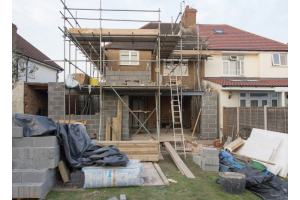

Choosing insulation for a renovation in Greater Manchester is not as simple as picking whatever's cheapest at the builders' merchant. The region's older housing stock, a mix of Victorian terraces, 1960s semi-detacheds and converted mill buildings, throws up real challenges around airtightness, moisture, existing wall construction and the specific thermal demands of a northern climate.
It is worth giving this thought and getting it right, as it can help lower energy bills, ensure a better-heated property, and a renovation that sails through building control.
Most Common Choice for UK Renovations
For most domestic retrofit projects in the UK, mineral wool (specifically rock wool or glass wool) remains the go-to choice due to its low cost, ease of installation, fire resistance and acoustic performance. PIR (polyisocyanurate) board is the preferred option where space is limited and maximum thermal performance per millimetre is needed, such as in solid wall insulation, flat roof build-ups or internal wall insulation where losing room depth matters.
PIR vs Mineral Wool
PIR board achieves a lambda value of around 0.022 W/mK, which is roughly twice as thermally efficient per millimetre as mineral wool, which typically sits at 0.032 to 0.044 W/mK depending on density. In practical terms, that means you can hit the same U-value target with significantly less thickness using PIR, which matters enormously when you're insulating internally, and every centimetre of lost floor area adds up across a whole house.
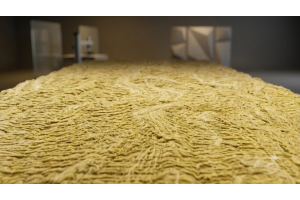
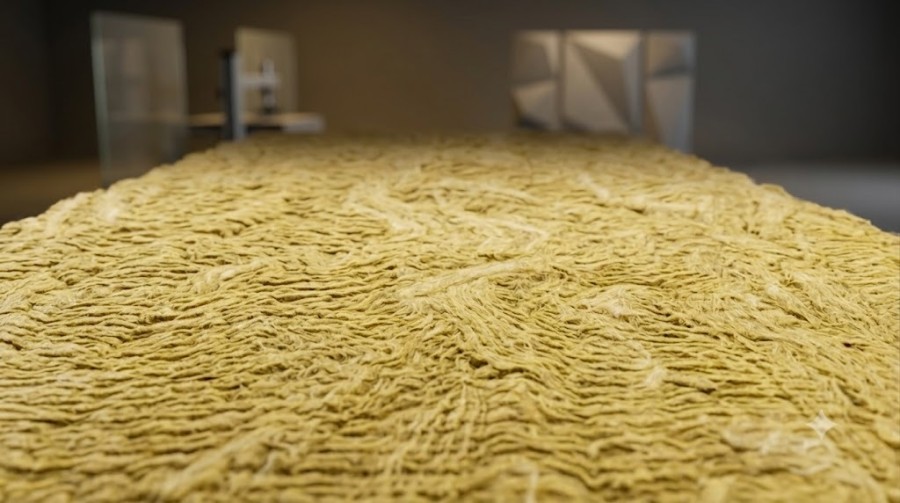
Mineral wool, whether you're using Rockwool RWA45 or Knauf Earthwool, has a different set of strengths. It's vapour permeable, which makes it much more forgiving in older buildings that need to breathe. It handles fire exceptionally well, has better acoustic credentials, and is considerably cheaper per square metre. For a standard stud partition, loft insulation or cavity fill on a 1980s build, mineral wool is almost always the sensible answer.
Performance Comparison Table
Material | Thermal Rating (Lambda) | Cost Tier | Best Application |
PIR Board (e.g. Celotex, Kingspan) | 0.022 W/mK | Higher | Flat roofs, internal wall insulation, solid floors |
Mineral Wool (Rock/Glass) | 0.032–0.044 W/mK | Lower | Loft, stud walls, cavity walls, acoustic partitions |
EPS (Expanded Polystyrene) | 0.036 W/mK | Mid | External wall insulation (EWI), below slab |
Spray Foam | 0.030–0.040 W/mK | Higher | Hard-to-reach cavities, irregular structures |
Rigid Phenolic Board | 0.018–0.020 W/mK | Highest | Where ultra-thin profiles are critical |
UK Building Regulations: What You Actually Need to Know
Part L of the Building Regulations (Conservation of Fuel and Power) sets the minimum thermal performance requirements for renovation work, and the 2021 revisions tightened things up considerably. For extensions and new builds, exposed elements now need to hit U-values of 0.18 W/m²K for roofs, 0.26 W/m²K for walls and 0.18 W/m²K for floors. Renovations to existing elements are subject to the "consequential improvements" rules, meaning if you're touching more than 25% of a thermal element, you need to bring the whole thing up to standard.
The key point most people miss is that it's not just about hitting the number on paper. Building control will increasingly want to see evidence that the specification was installed correctly, and with insulation that means no gaps, no compression of mineral wool and proper treatment of junctions to avoid cold bridging.
A product with the right lambda value installed badly will consistently underperform against one with a slightly weaker spec installed well.
Acoustic Insulation
Thermal and acoustic performance are not the same thing, and the materials that excel at one don't always perform well at the other. PIR board, despite its thermal credentials, offers very limited sound absorption because of its rigid, closed-cell structure. Mineral wool, particularly high-density rock wool (RWA45 or equivalent), is the standard choice for acoustic partitions, party walls and floor build-ups between storeys. If you're converting a property into flats, working on an HMO or renovating a mid-terrace in Salford where the party wall is a genuine concern, the acoustic specification deserves as much attention as the thermal one.
Manchester's building stock presents a particular challenge here because many party walls in Victorian terraces have no insulation at all, and simply adding thermal insulation without addressing sound transmission is a missed opportunity, especially when the cost difference between standard and acoustic-grade mineral wool is minimal.
Retrofit vs New Build
New build gives you full control over the build-up and the ability to specify continuous insulation without thermal bridges, hit Passivhaus-level airtightness and incorporate membranes from the outset. Retrofit is an entirely different discipline. You're working within existing constraints: wall thicknesses, window reveals, existing services, floor-to-ceiling heights and, critically, the moisture behaviour of the existing structure.
In a solid-wall Victorian property, for example, the wrong choice of insulation can trap moisture against original masonry and cause long-term damage. Vapour-open insulation like mineral wool or wood fibre is generally safer in these situations. Internally insulating a solid wall with PIR without a carefully designed vapour control layer strategy is a route to condensation problems that won't show up for two or three years.
Where to Get the Right Materials in Greater Manchester?
Getting the specification right is half the equation. You also need a reliable local supplier who carries stock across the range, can advise on what's available, and isn't going to leave your site waiting a week for a pallet of PIR to arrive from a national depot.
For trade contractors and homeowners working across Oldham, Salford and the wider Manchester area, Joseph Parr Alco supplies a full range of compliant insulation materials and can support both the specification stage and the day-to-day material requirements of renovation jobs.
Get in touch for specific guidance on insulation projects.